
For much of the past decade we have measured progress in land-based aquaculture in tonnes. The ambition to grow salmon and other high-value species on land, close to the market, drove a race to build ever larger recirculating aquaculture systems (RAS), meant to rival the output of a whole sea-cage operation. The ambition was right. The assumption that came with it, that bigger automatically means better, was not.
We have spent years engineering water treatment for these systems, and the pattern in the failures is clear. Budgets that ballooned, biological setbacks that wiped out months of biomass, start-ups that ran past plan. RAS works; that is not the question. What decides the outcome is how a system is engineered and sized, not how large it is. That is why we believe the next phase of this industry belongs not to the mega-farm but to the compact, modular, factory-built unit.
RAS is engineering, not procurement
A RAS is not a shopping list of equipment. It is the engineering of a living system. In a single loop you keep hundreds of tonnes or pieces of fish alive by turning the same water over several times an hour, so mechanical filtration, biological treatment, gas transfer and disinfection all have to work together inside one hydraulic balance. Undersize one unit and the whole chain comes down with it.
The numbers are unforgiving. Every kilogram of feed puts roughly 0.3 to 0.5 kg of suspended solids, 0.03 to 0.05 kg of ammonia and up to 1.4 kg of carbon dioxide into the water, while consuming close to a kilogram of oxygen. Ammonia grows far more toxic as pH rises, and a four degree temperature drop can shift biofilter sizing by a quarter. Every target has to hold continuously, at peak load, not on a good day. You do not hit them by buying a bigger pump, but by calculating every unit from the biological basis of design and sizing it to hold when the system works hardest.
This is where the most expensive mistakes are made, on paper, months before any fish arrive. Too often the design phase is treated as a cost to cut, and a system is put together by copying the last project instead of engineering. In our view that habit is the single biggest risk in RAS today. A proper design phase is not an overhead; it is the project’s insurance policy, the step that closes down failures that would otherwise surface on site and cost months and lost biomass to fix.

We also hear the counter-argument from investors constantly. Done properly for a bespoke plant, that design phase is a serious cost in time and money, and many developers cannot carry it. This is exactly where compact, modular units change the equation. When the engineering is already built into a proven, repeatable unit and spread across many builds, the buyer inherits that rigor without paying for a full custom design cycle. The discipline that protects the project stops being a luxury only the largest budgets can afford.
Why scale amplified the wrong risks
Scale did not create these truths, it magnified what happens when you ignore them. Assemble a very large facility from units bought separately, a drum filter from one supplier, a biofilter from another, oxygenation from a third, and nobody owns the interfaces between them. Each unit can be fine on its own while the system fails, because the flow leaving one step does not match the next, and the integration happens for the first time on site, under pressure, with fish already on the way.
Scale also front-loads the risk. One enormous loop concentrates the whole production plan into a single biological system commissioned all at once, with a biofilter that needs six to twelve weeks to establish its bacteria before it can carry full load. If anything is wrong, everything is wrong at the same time, and the money was committed years before the first harvest, too late for the lessons to change the design.
What compact and modular actually solves

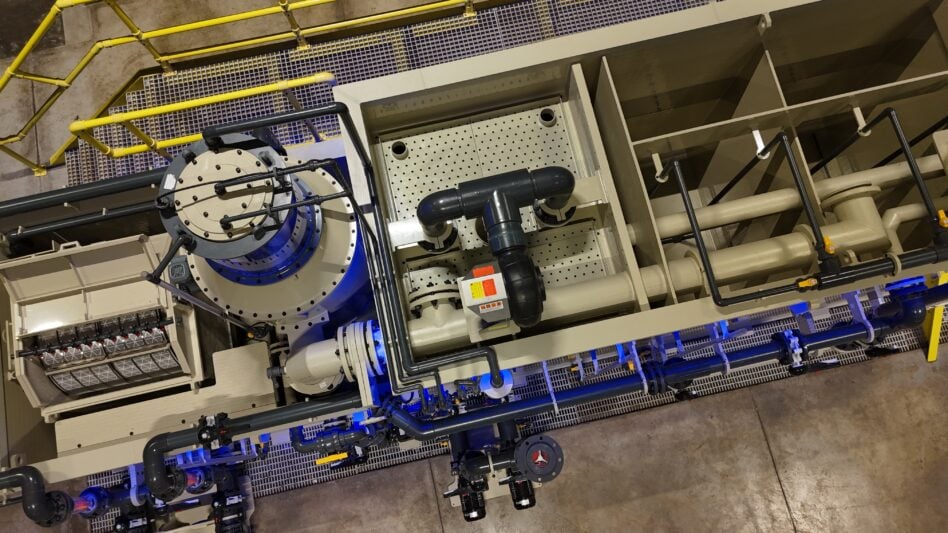
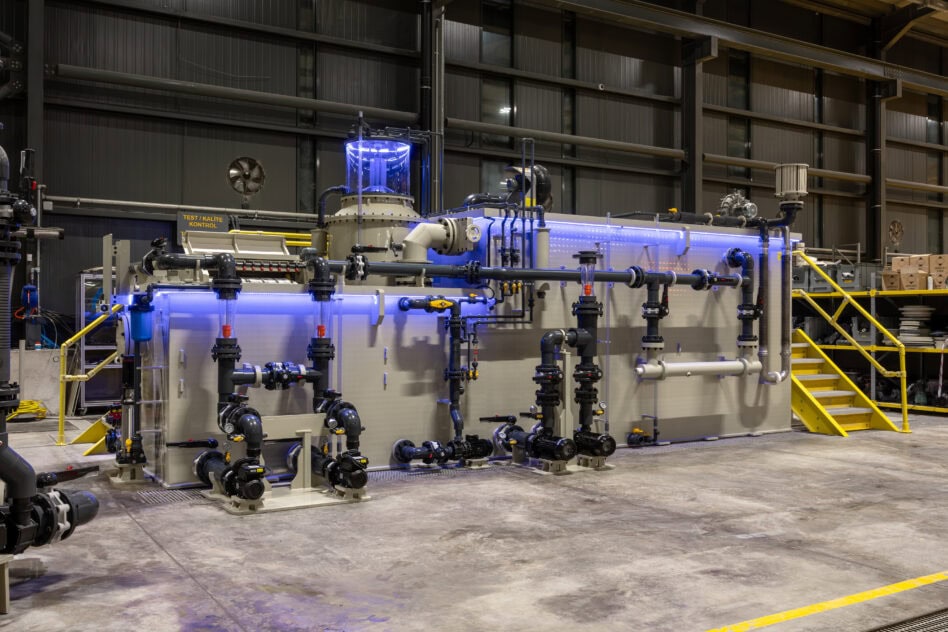
Compact, modular units answer these problems directly. The idea is simple: instead of integrating a water treatment plant for the first time on the farm, you do it in a factory, prove it, and ship a tested system. A compact RAS skid brings the full treatment chain including micro-screen drum filtration, protein skimming with ozone, the moving-bed biofilter, UV-C disinfection, degassing, oxygenation, with the pumping, sensors and automation, into one pre-piped, pre-wired unit engineered for a given species, biomass and water source. We build these at MAT-KULING as CRAS units, but the principle matters more than any one product. Because the skid is fully assembled and tested in the factory before it ships, multi-vendor interface problems are solved where they are cheap to solve. On-site work shrinks to connections and commissioning, and the installation cost falls by roughly a third against compared with buying loose, standalone equipment and assembling it on site. Engineered as one system, with piping and pumps selected together, it runs on less energy, day after day.
There is a cost argument the industry underrates. In a typical land-based RAS project today, in our experience close to 30 per cent of the budget goes into civil works and building services. Much of that is custom concrete, the channels, sumps and compartments cast on site to hold the treatment units, bespoke, slow and expensive. A skid-built treatment train removes most of that concrete: the units arrive in their own engineered housing and need no custom civil structures poured around them. Cut the concrete and you cut both the cost and the months of site work that come with it.
This is the fear investors raise most: projects today are full of trouble during installation and commissioning, a load of risks investors cannot carry. Let the mistakes happen in the factory, not on site. A skid that has already run and been corrected in Izmir does not spring its surprises on a live farm with biomass in the tanks.
There is a deeper advantage only a repeatable unit can give. Every project teaches us something, about a species related requirements, a water source, a site, a failure mode, and with a compact unit that learning is never lost when the project closes. It feeds back into the design, so each generation is better than the last, and can be pushed to units already in the field as an upgrade after delivery. A client who buys a compact module is not buying a one-off, but the accumulated experience of every project before them, in the most reliable form we know.
Modularity also gives back what the scale-first approach threw away: the ability to grow in steps, and this is where it rescues the business case. A farm can start with the capacity it can finance and run, learn from a working loop, and add modules as biomass and confidence build; if a problem appears, it stays inside one module instead of threatening the whole site. Instead of sinking the full capital cost up front, a producer phases the investment against a module that is already earning, proves the biology and the business model, and funds expansion from cash flow rather than optimism. To a lender, a plant built from proven, repeatable modules is far more bankable than one first-of-its-kind giant, and easier to permit, often the difference between a project that reaches financial close and one that never leaves the drawing board.
We want to be precise about what modular means, because it is not a catalogue. Every serious RAS is still sized from first principles: feed rate, water quality targets, temperature, salinity and peak load. The answer is a family of standard sizes, each still engineered to order. Our CRAS range runs to eight models, from roughly 10 up to 1,000 m³/h of treatment flow, so a project picks the band it needs and the unit is tailored to species, water source and location. The standardisation lives in the process and the quality control, not in a one-size-fits-all box. That is what lets the same discipline serve hatcheries, smolt, grow-out, research sites and mobile or container systems.
The bigger stakes
Compact units also lower the barrier for smaller operators and water-scarce regions, while a well-designed RAS still recycles more than 90 per cent of its water as European discharge rules tighten. None of this makes large facilities obsolete; there will always be a place for scale where the biology and the market justify it. But the centre of gravity in RAS is shifting, from how big can we build toward how well can we engineer, test and repeat. Compact and modular units are where that shift becomes real. They take the discipline that separates the RAS projects that succeed from the ones that fail, and build it into a unit proven before it is ever trusted with fish. For us that is not a step down from the ambition of land-based aquaculture. It is how that ambition finally becomes reliable.
REQUEST A QUOTE FOR CRAS HERE